
How to offer a client a personal discount and what to write
September 18, 2026 · updated October 26, 2026
Screenshots show the Russian-language interface.

A discount works when it’s understood and when it doesn’t look random. Two mistakes are the most common. The first: writing “we have a promotion, 20% off” and leaving the client to guess whether it applies to them. The second: promising a discount and forgetting about it at booking, after which you have to awkwardly recalculate the price. Below are texts for different situations, and at the end — how to attach a discount to a client so you don’t have to remember it.
What a good offer consists of
A discount message should contain four things:
- A reason. “You’ve been with us since we opened”, “you brought a friend”, “first visit”. The reason turns a discount from a sale into a gesture of attention.
- An amount. A specific number: “10%” or “300 ₽”. The words “a nice discount” say nothing.
- A deadline. “Until the end of the month” makes people decide now. A discount without a deadline gets postponed forever.
- What to do. Reply in the chat, book via the link. The fewer the steps, the better.
To a new client
The first booking is the hardest spot: the client doesn’t know you. A discount lowers the risk of trying.
Hello, Anna! You haven’t been to us yet, so for you there’s a 10% discount on your first visit. It’s valid until the end of October. You can book via the link: [link].
If the client was brought by an acquaintance, say so:
Anna, hello! Maria told us about you, and we’re happy to meet you. For you there’s a 10% discount on your first booking, valid until October 31.
To those who’ve been coming since the opening
Here the discount isn’t an incentive but a thank-you. So it doesn’t need a deadline, and the tone is different.
Anna, you’ve been with us since the first month, and we want to mark that. You now have a permanent 10% discount on all services. There’s no need to remind anyone, it will be applied to every booking.
If you don’t want to promise “forever”, name a period:
Anna, thank you for being with us for a year now. For the next three months there’s a 10% discount on any service for you.
To a client who hasn’t come in a long time
The important thing here is not to push and not to reproach. A discount is a reason to come back, not a reproach. Why clients disappear in the first place and how to tell who has left for good, we covered in Why clients don’t come back to a beauty pro.
Hello, Anna! We haven’t seen you in a while. If you’d like to stop by, until the end of the month there’s a 15% discount on any procedure for you. You can pick a free time via the link: [link].
A client’s birthday is a good occasion for such a message. Ready-made texts with a discount as a gift are in Birthday wishes for clients.
What it’s better not to write
- “A discount just for you, but don’t tell anyone” — the client tells a friend, and you end up explaining the difference.
- “50% off!” with no reason — the client decides the regular price is inflated.
- A discount with no deadline and no reason — it doesn’t motivate and devalues the price list.
- A request to “remind me about the discount when booking” — you’re shifting the work onto the client.
How to do this in Talenza
In Talenza you don’t need to remember a discount. A personal discount is attached to a client once: in “Settings” → “Services and discounts” → “Discounts”, or from the client’s card. After that it’s applied to their bookings on its own, both when you book them in your cabinet and when they book through your link.
A discount can be a percentage or a fixed amount, it can have an expiry date (“Valid until”), and you can mark it “One-time”: it will expire after the first use. That’s convenient for an offer to a new client: the deadline and one-time nature are set in the discount itself, and there’s nothing to keep track of. A single client can have only one personal discount.
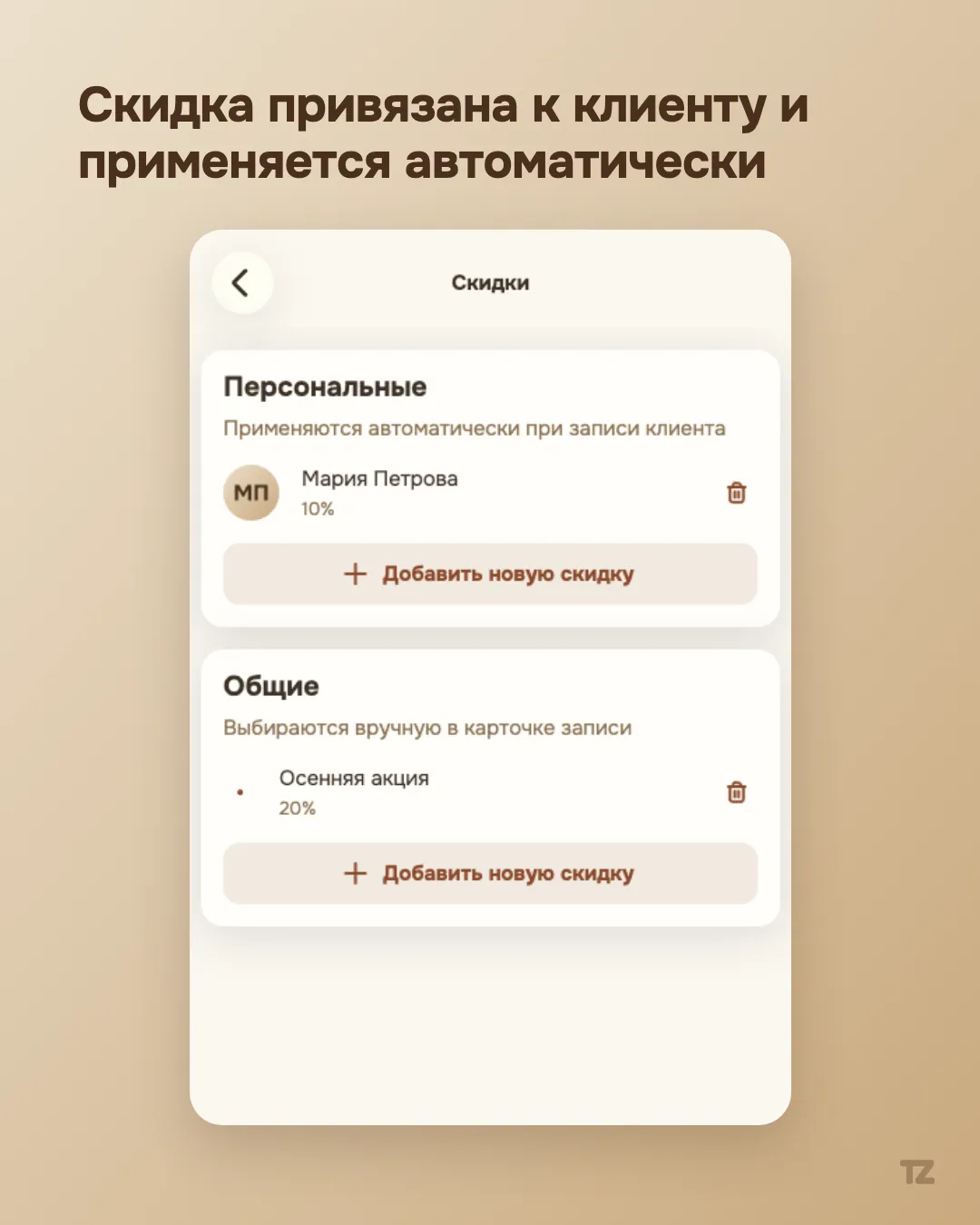
The client sees the discount on their booking page: the old price is crossed out, with the discounted price next to it. So in the message you don’t need to explain the arithmetic, it’s enough to name the amount.
We covered how the discount mechanics work in the article a personal discount for a client: assign it once, and step-by-step instructions are in the knowledge base: How to give a client a discount. If you’d like to please a client with a gift rather than a discount, take a look at gift certificates.
A discount also helps soften a price increase for regular clients: how to raise prices without losing them is in “How to raise your prices without losing clients”.
Frequently asked questions
How do I offer a new client a personal discount? Name the reason, the amount, and the deadline: “For you, 10% off your first procedure until the end of the month”. A discount without a deadline doesn’t motivate anyone to book, and a discount without a reason looks like an attempt to lure the client.
How do I give a discount to clients who’ve been coming since the very beginning? Say directly that you value it, and attach the discount to the client with no end date. For such clients, a percentage discount on all visits works better than a one-off promotion.
How do I properly write to a client about a personal discount? Briefly and without pressure: what it’s for, how much, until what date, and what needs to be done to get it. It’s best if the client doesn’t have to remind you of anything when booking.