
The full value is spent to the last ruble
September 8, 2026
Screenshots show the Russian-language interface.

Before the holidays, pros’ gift certificates sell out: a client gives a loved one a booking for a haircut, manicure, or massage without choosing a specific date in advance. It’s lovely for the giver — but the person receiving the gift is often upset that the face value can’t be spent to the last ruble: the difference simply disappears. We decided that a happy client is a benefit for the pro too, and set up the certificate in Talenza so that the balance is never lost.
A certificate is a wallet, not a ticket for a single visit
The most common expectation of a gift certificate is that it’s redeemed with one booking in full, and if the service costs less than the face value, the remainder is simply lost. In Talenza it isn’t so. A certificate is a cash balance capped at its face value: the pro sets the amount and a mandatory expiration date, and then the certificate can be spent across several visits in a row while the balance lasts. Came for a manicure costing half the amount — the other half doesn’t go anywhere and waits for the same client’s next booking with the same pro. The only real limit is that one booking can’t cost more than what’s left on the balance: the certificate doesn’t give change in cash, but there’s no “burning” of the remainder either.

The client enters the code themselves, when booking online
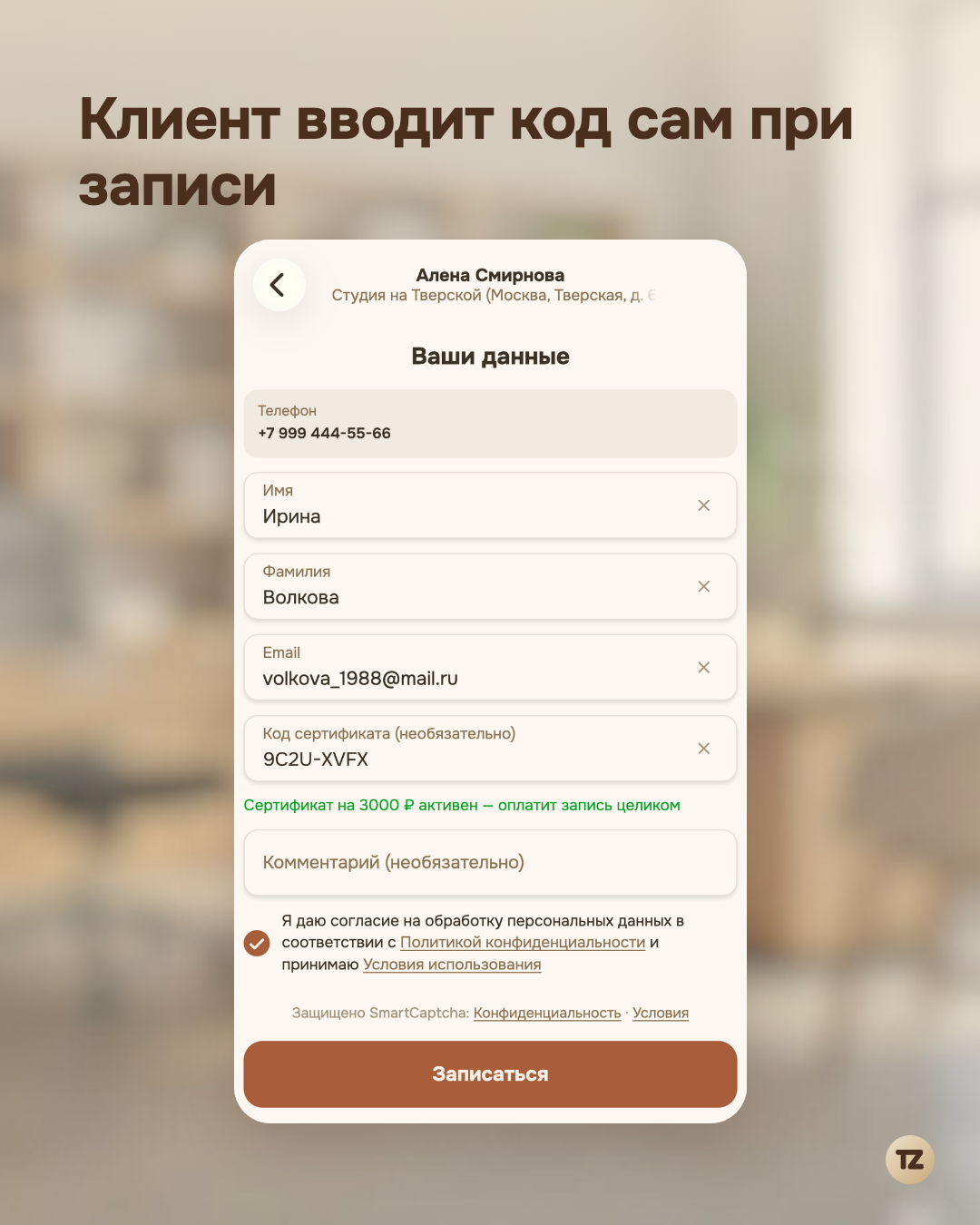
The second typical solution for certificates is to make redeeming them the pro’s job: the client names the code by phone or in chat, and the pro types it into their system. At Talenza this path works differently. The certificate code is a separate field right on the online booking page, next to the name and phone. The client enters it themselves, and the app immediately shows that the certificate was found, is active, and for what amount — before the booking is confirmed. The pro doesn’t have to do anything for this: the amount is deducted automatically when the booking is created. The ability to correct or add a code by hand from the pro’s dashboard is still there — but as an extra path for non-standard cases, not the only way to redeem a certificate.
The code is deliberately made easy to dictate or copy from a piece of paper: eight characters with no letters and digits that visually get confused with each other.
Canceling a booking — the money returns to the balance
If something goes wrong and a booking paid with a certificate is canceled, the deducted amount doesn’t stay deducted just because the booking didn’t happen — it goes back to the certificate’s balance. The same happens with subtler edits: if the pro changes a booking before canceling it or recalculates its cost because of a change of service, the certificate deduction is recalculated along with it rather than staying tied to an outdated amount. The whole history — which bookings were paid with this certificate and how much is left of it — is visible to the pro in one place, with no need to remember or recalculate by hand.
Selling stays the same as it was
One thing in Talenza’s certificates was deliberately left unchanged: the sale itself. The pro creates a certificate in the app, filling in only the face value and expiration date — the code is generated automatically. After that, the pro receives the money for the certificate from the client directly, in any convenient way, exactly as they did before without any app. Talenza doesn’t process this payment and doesn’t act as an intermediary — it only counts how much of the certificate is left, and does so accurately after every booking, without manual calculations.
The bottom line is simple: a certificate stops being a source of confusion at the end of the year. The pro spends one two-field form on setting it up, the client — one field during a regular online booking, and a happy client who spent the certificate down to the last ruble is a benefit no smaller than for the client themselves.