
How to ask a client whether they're coming: ready-made messages
August 31, 2026
Screenshots show the Russian-language interface.

For a solo pro, an empty gap in the schedule is a specific hour that can’t be sold to anyone else. That’s why the question “will the client come?” comes up before every booking. Below are ready-made texts for different cases. They aren’t tied to any app: you can send them from any messenger, and at the end we’ll show how it’s done in Talenza.
Three rules for a good message
A message like “See you tomorrow!” doesn’t find anything out. The client reads it and doesn’t reply, and you still don’t know whether they’re coming. The texts that work contain three things:
- Specifics. The date, time, service, and address in one message, so the client doesn’t have to dig through the chat.
- A question that’s easy to answer. “Confirming?” is a one-word question. “How are things with your booking?” is a question nobody wants to answer.
- A way out. The phrase “if your plans changed, write to me and we’ll reschedule” removes the awkwardness. A client is more willing to admit they can’t come when they won’t be scolded for it.
Texts for the day before the booking
The main case: you write the day before, while the freed-up hour can still be offered to someone else.
Hello, Anna! A reminder: tomorrow at 3:00 PM we’re expecting you for a manicure. Address: 12 Sadovaya St. Confirming your booking? If your plans changed, write to us and we’ll find another time.
A short version for regulars you’re on first-name terms with:
Hi! Tomorrow at 3:00 PM I’m expecting you. All still on?
If the booking was made a long time ago rather than a couple of days ago, add a reminder of the service itself: the client may have forgotten not only the time but also what they booked.
Hello, Anna! You booked for October 14, 3:00 PM, for eyelash extensions. A reminder that the procedure takes about two hours. Confirming?
Texts for the morning of the visit
This is the second message, if yesterday’s went unanswered. It’s shorter and more direct.
Good morning, Anna! Today at 3:00 PM I’m expecting you. Please let me know whether you’re coming, so I know whether to hold this time.
If you work on location or the client travels a long way, ask about the trip:
Good morning! We’re meeting today at 3:00 PM. Are you setting out already, or does the time need to be moved?
What to write if the client is silent
A client’s silence doesn’t mean they won’t come. But counting on them without a reply is risky too. What you can do:
- Write a second time in different words, rather than repeating the same message.
- Call 2–3 hours before the booking. A call is more reliable than text: if the client doesn’t pick up, you at least know the time should be offered to someone else.
- Offer a reschedule instead of the question “are you coming”:
Anna, hello! I see you haven’t replied yet. If today doesn’t work, let’s move it to another day, that’s not a problem. Just write when it suits you.
If you ask them to call back, give the client a reason and a deadline:
Hello! I need to confirm your booking for tomorrow. Please call me before 6:00 PM or reply to this message.
If the client didn’t reply: wait or not
There’s no single rule, but there’s an approach: decide in advance and tell the client. For example, add to the first message: “I’ll wait for you until 3:15 PM”. Then you’re not inventing conditions at the moment the client is already late, and the client understands what’s expected of them. If a pro waits “as long as it takes” and then cancels, it looks like resentment. If the deadline was named in advance, it looks like a rule.
How to do this in Talenza
You don’t have to type the same texts every time. A future booking’s card has a “Remind the client and request confirmation” button. It opens a sheet with ready-made text: you set up the template once, and the client’s name, date, time, service, and address are filled in by themselves. Then you choose how to send it: copy it, send via Telegram, WhatsApp, SMS, or through the system “Share” menu.
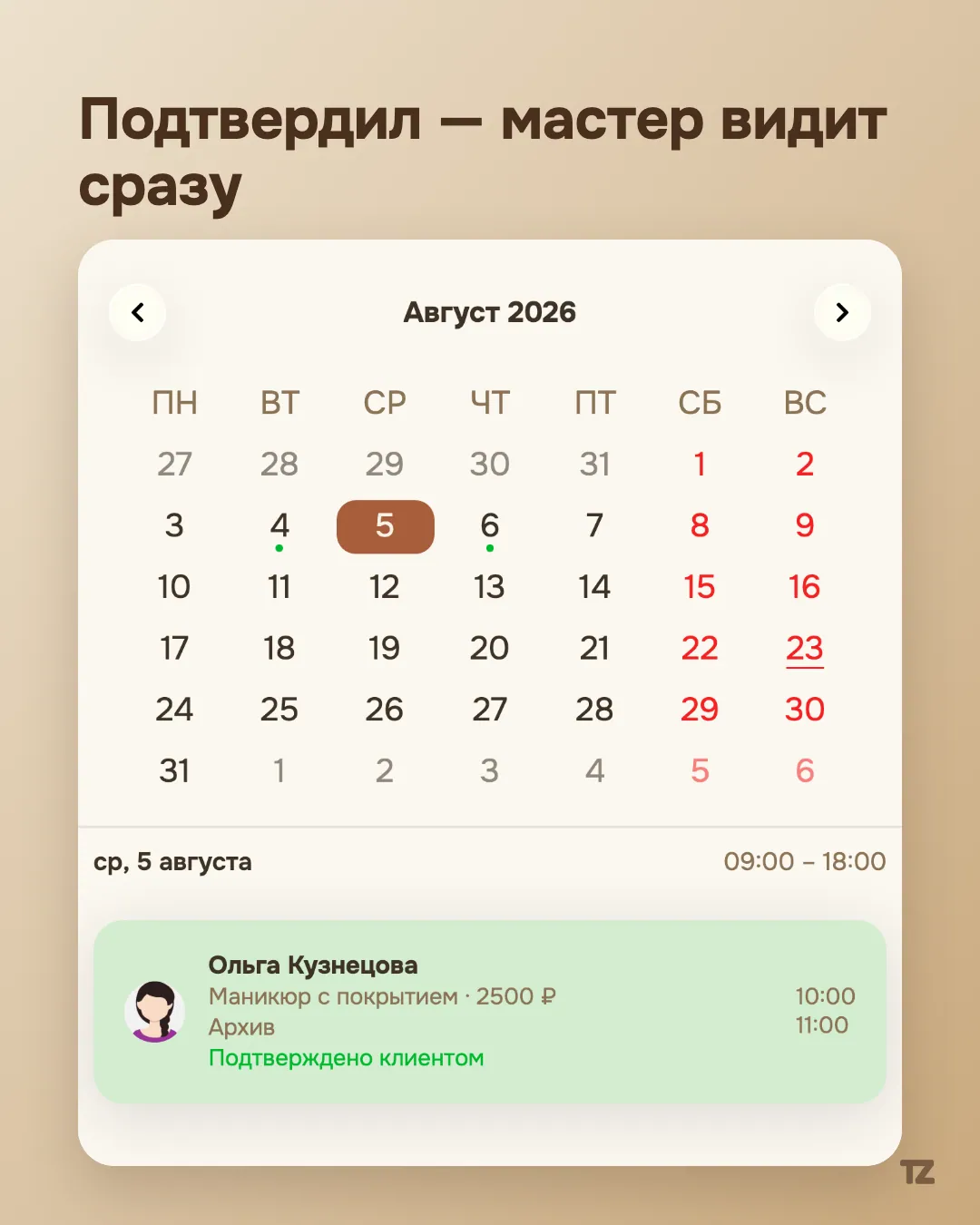
The client receives a link to their booking page and can confirm it with one tap. If they have the Telegram bot connected, the confirmation arrives right in the chat. The answer is visible in the day’s list: a “Client confirmed the visit” mark appears next to the booking, and for those who stay silent — “Client hasn’t confirmed the visit yet”. That way you can see right away who needs a second message or a call.
For more on how reminders and confirmation work, see the article how reminders and booking confirmation work in Talenza. For the free channel, see reminders via Telegram, and for how to turn it on in settings, see the guide. If a freed-up slot needs to be offered to others quickly, Free slots will help.
A confirmation a day ahead works better when the client has clear rules for rescheduling and cancelling. What to put in them and how to say it is in “Booking rules for a solo pro: reschedules, cancellations and prepayment”.
Frequently asked questions
How do I properly ask a client whether they’re coming to their booking? The day before, send a short message with the date, the time, and a question that can be answered in one word: “Confirming your booking tomorrow at 3:00 PM?”. A question with a ready answer works better than a plain “we’re expecting you”.
If a client hasn’t confirmed, should I wait for them? Silence doesn’t mean a refusal. Write a second time on the morning of the visit, and if there’s no reply, call 2–3 hours before the booking. If it’s still quiet after that, decide in advance how long you’re willing to wait and tell the client.
How do I write to a client that we’re expecting them without sounding pushy? Give information, not pressure: the date, the time, the address, and one phrase saying the booking can be rescheduled. Then the message reads as care rather than a check-up.